WordPress 7.1 Set for August 19, 2026 Release
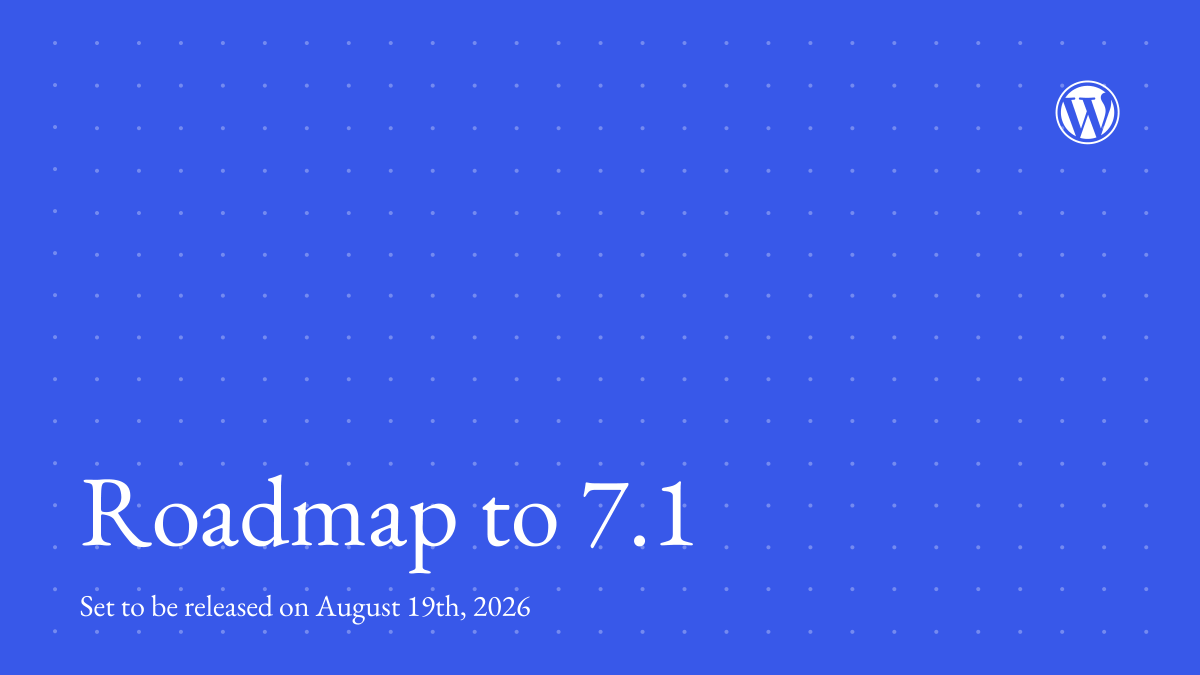
WordPress 7.1 is scheduled for release on August 19, 2026. This update promises to enhance collaboration workflows, expand styling capabilities within the Site Editor, and introduce editorial guidelines integrated with AI tools.
- WordPress 7.1 introduces richer asynchronous collaboration with Notes enhancements including suggestion mode and emoji reactions, while real-time collaboration remains under strategic development.
- Site Editor gains new responsive and pseudo-state styling options, reducing reliance on custom CSS for common design needs.
- A new persistent Guidelines feature encodes editorial rules directly into WordPress to maintain brand voice and content standards, especially when working with AI.
- Media management sees improvements like a free-form image cropper and client-side support for additional image formats, enhancing user control and upload resilience.
- For developers, expanded APIs, improved Unicode support, and enhancements to the AI Client and Connectors frameworks offer deeper integration possibilities and global readiness.
What Happened
According to the official WordPress Core blog, the 7.1 release is focused on improving collaboration, styling, editorial control, and extensibility. New Notes features will add suggestion mode and emoji reactions, making asynchronous feedback within WordPress more interactive. Real-time collaboration remains a focus with key decisions still pending on its implementation.
Styling improvements include new options for responsive and pseudo-state styling in the Site Editor, addressing long-standing requests to handle these without custom CSS. A new Guidelines feature, initially tested in Gutenberg, allows users to define and share editorial rules that integrate with AI tooling, maintaining consistency in brand voice and editorial preferences.
The user experience is further enhanced by better navigation features such as an updated command palette with grouped recent and suggested commands, an admin bar visible inside editors, and a new Identity section consolidating site title, tagline, logo, and favicon settings in one place.
Media handling improvements include a new free-form image cropper and client-side enhancements supporting more image formats and increasing upload resilience. Developers will benefit from expanded AI Client capabilities like generation streaming and embeddings, as well as new authentication methods for Connectors beyond API keys.
Additional updates include a redesigned command palette, admin color scheme integration into the Site Editor, and ongoing work on the Design System‘s shared component library and theming infrastructure.
Why This Matters
For agencies managing multiple WordPress sites, 7.1’s Notes enhancements and Guidelines feature represent a meaningful step toward streamlining editorial workflows, especially in remote or asynchronous team environments. The ability to embed editorial rules directly into WordPress reduces inconsistencies and reliance on external documentation, which is critical when integrating AI-assisted content generation.
In production WordPress stacks, expanding responsive and pseudo-state styling options directly in the Site Editor reduces the need for custom CSS and developer intervention for common design scenarios. This shift empowers site editors to manage nuanced styling states like hover or focus across device sizes more intuitively, cutting down iterative design cycles and support tickets.
Real-time collaboration remains complex to implement securely and seamlessly within WordPress’s existing architecture. Holding off on finalizing this feature allows the project to make informed strategic choices without rushing. This cautious approach protects developers and site operators from premature releases that could introduce instability or complicate maintenance.
On the media front, improvements like the free-form cropper and support for additional formats address a common pain point for site operators: achieving pixel-perfect images without external tools. Client-side enhancements also mitigate issues related to slow or unstable uploads, reducing frustration for content teams working under tight deadlines.
From an ecosystem perspective, expanding the AI Client and Connectors API capabilities with generation streaming, embeddings, and richer authentication options signals WordPress’s ongoing commitment to integrating AI and external services in a developer-friendly way. However, plugin authors will need to adapt to these changes and test compatibility thoroughly.
What This Means for WordPress Users
Should agencies and site operators care? Yes. If you manage editorial teams or collaborate with clients remotely, the new Notes and Guidelines features can significantly improve feedback quality and consistency, particularly when AI tools are involved.
Should developers act now? Developers should begin exploring the expanded AI Client and Connectors APIs to prepare for new integration possibilities. Testing against 7.1 beta releases will help identify any breaking changes or opportunities for enhancements.
What should site operators change? Operators should familiarize themselves with the new Identity section and styling options to streamline site setup and design management. Training content editors on the updated Notes workflow and Guidelines feature will maximize their effectiveness.
Overall, WordPress 7.1 is less about flashy new features and more about deepening collaboration capabilities, reducing friction in styling, and introducing editorial consistency mechanisms that align with AI workflows. These changes reflect WordPress’s evolution toward a more integrated, user-centric platform for complex, multi-user environments.
Frequently Asked Questions
1. What exactly is the new Guidelines feature in WordPress 7.1?
Guidelines provide a structured way to encode editorial rules and brand voice directly into WordPress. This helps humans and AI tools maintain consistency when creating or editing content, especially useful in collaborative and AI-assisted workflows.
2. How does the improved command palette enhance site editing?
The command palette now groups commands into recent, suggested, and matching categories, making it easier to find and reuse commands. It also saves recently used commands across sessions, improving navigation efficiency for power users.
3. Will real-time collaboration be available in WordPress 7.1?
Real-time collaboration is still under development with some strategic decisions pending. It may not be fully implemented in 7.1 but remains a focus for future releases.
4. What improvements have been made to media handling?
WordPress 7.1 introduces a free-form image cropper and client-side media enhancements supporting additional image formats and improved upload resilience, giving editors more control and reliability when managing media.
5. How will developers benefit from the AI Client updates?
The AI Client gains generation streaming and embeddings support, allowing plugin authors to enable more advanced AI-driven content generation and semantic search features within WordPress sites.